Guides
5 Equipment Rental Yard Layout Mistakes That Slow Down Returns
Equipment rental yard layout mistakes cost return time every day. Five failures, their causes, and the fixes that keep machines moving in and out.
What to take away
- Most return-lane delays trace back to layout, not staffing. A yard that mixes parking, washing and dispatch in one apron will always feel short-handed.
- The worst mistakes are invisible for a season or more. Ponding water, blind corners and undersized wash bays show up as slow damage claims, not as a stoppage you can see.
- Fixing flow usually costs less than adding a machine. Re-striping, moving the wash bay and widening one gate often buys more capacity than another telehandler.
- OSHA rules on exit routes and materials handling set the floor, not the target. A yard can be legal and still be slow.
The costly one: one apron doing four jobs
Picture a 6 acre yard outside Phoenix. Machines come back dirty, get parked wherever the driver finds space, and wait for wash. Dispatch then pulls units from the same lane.
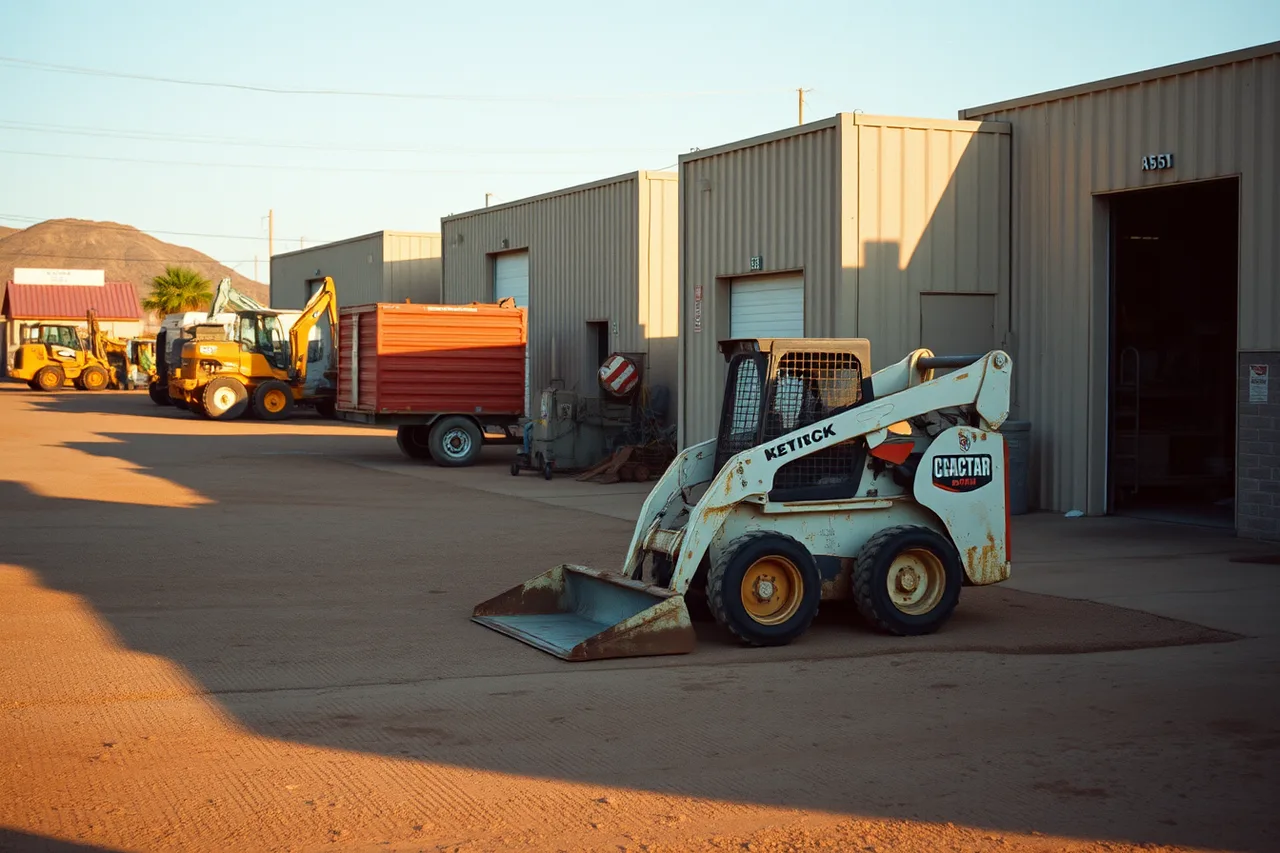
The consequence is a return lane that is blocked for hours at a time. A skid steer that should be turned in 30 minutes sits for a day. Multiply that across a busy spring and the yard needs more iron to cover the same work.
Prevention is separation. Give returns their own gate, their own wash bay and their own staging row. Keep dispatch on the opposite side. Where space is tight, a one-way loop with returns entering at the rear and leaving at the front does most of the work.
On a 6 acre yard, a 12 ft wide by 200 ft long return lane uses about 2,400 sq ft. A second wash pad of 30 ft by 50 ft uses 1,500 sq ft.
OSHA's materials handling and storage standard, 29 CFR 1910.176, requires safe clearance for mechanical handling equipment, which is the legal version of the same point.
Mistakes 2 to 4: wash bay, aisle width and return lane
Mistake 2: the wash bay nobody sized
A single wash bay at the back of the lot looks efficient on a plan. In practice it becomes the bottleneck every Monday morning.
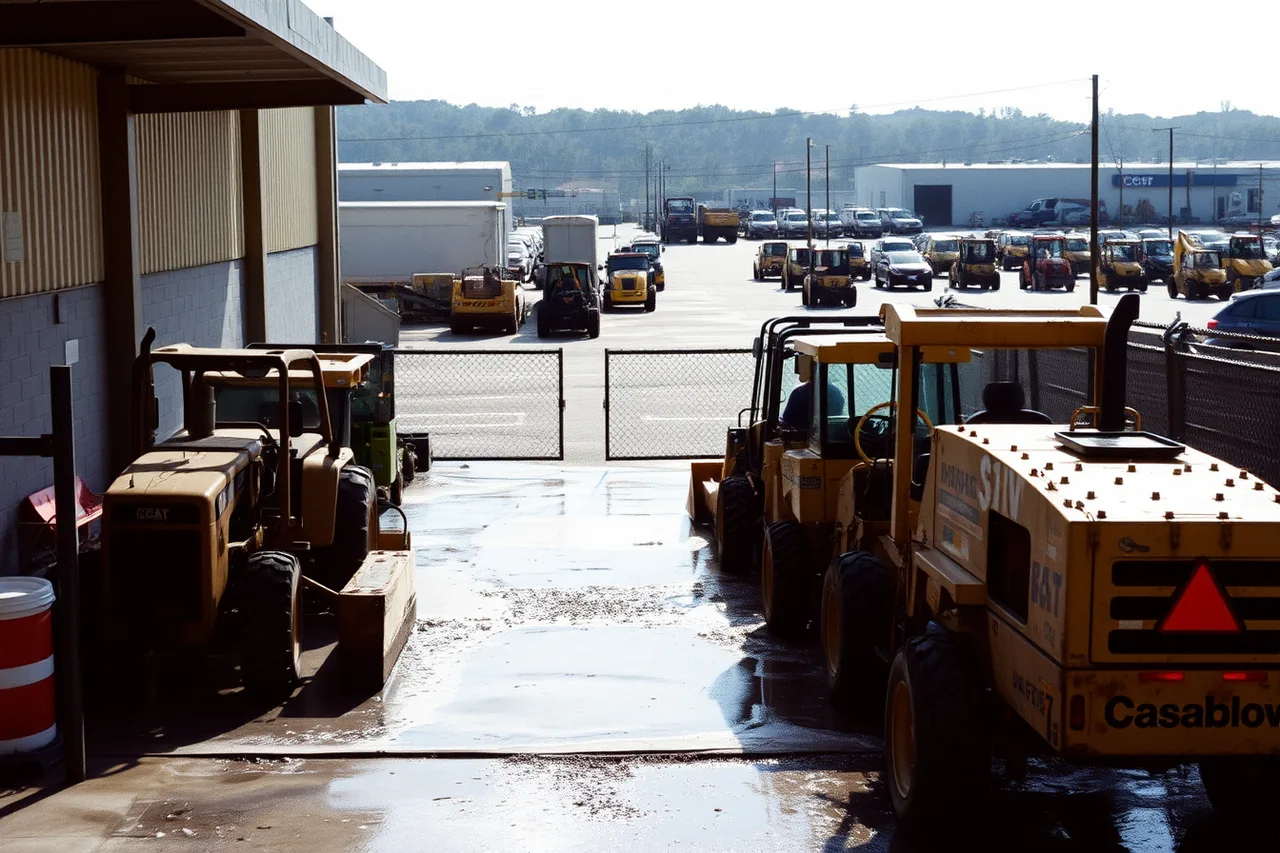
Cause: the bay was sized for average demand, not peak. Consequence: units queue in the return lane and block the gate. Prevention: size the wash area for the busiest two days of the week and add a second pad, even if it is only a gravel apron with a drain.
Mistake 3: storage rows that ignore turning radius
Compact lots in Chicago and older industrial districts often inherit aisles built for box trucks, not for a 12,000 lb telehandler with a load.
Cause: the row spacing was copied from a parking lot. Consequence: operators take wide swings, clip racking and slow to walking pace. Prevention: measure the largest machine you rent and set aisle width from that number, not from a drawing. A 10,000 lb telehandler such as a JLG 1055 has an outside turning radius near 13 ft 6 in.
A right angle turn into a storage row usually needs 18 to 20 ft of clear aisle. A blind corner needs more.
Mistake 4: no marked return lane
Drivers improvise. A machine gets dropped in the first open spot, which is often the dispatch row.
Cause: nothing on the ground says where returns go. Consequence: the yard crew spends the first hour of each shift moving units by hand. Prevention: paint the return lane, post signs at the gate, and put the wash schedule on a board the drivers see before they park.
- Return lane painted and signed at the entrance
- Wash bay sized for peak week, with a second pad planned
- Aisle width set from the largest unit in the fleet
A layout that only works on a quiet Tuesday is not a layout. It is a hope.
Mistakes that show up later: drainage and blocked exits
Mistake 5: drainage that fails for a season
This is the mistake that stays hidden. A yard graded flat in October drains fine through winter. Then spring rain arrives, the low corner near the fence holds water, and the ground under the storage rows softens.
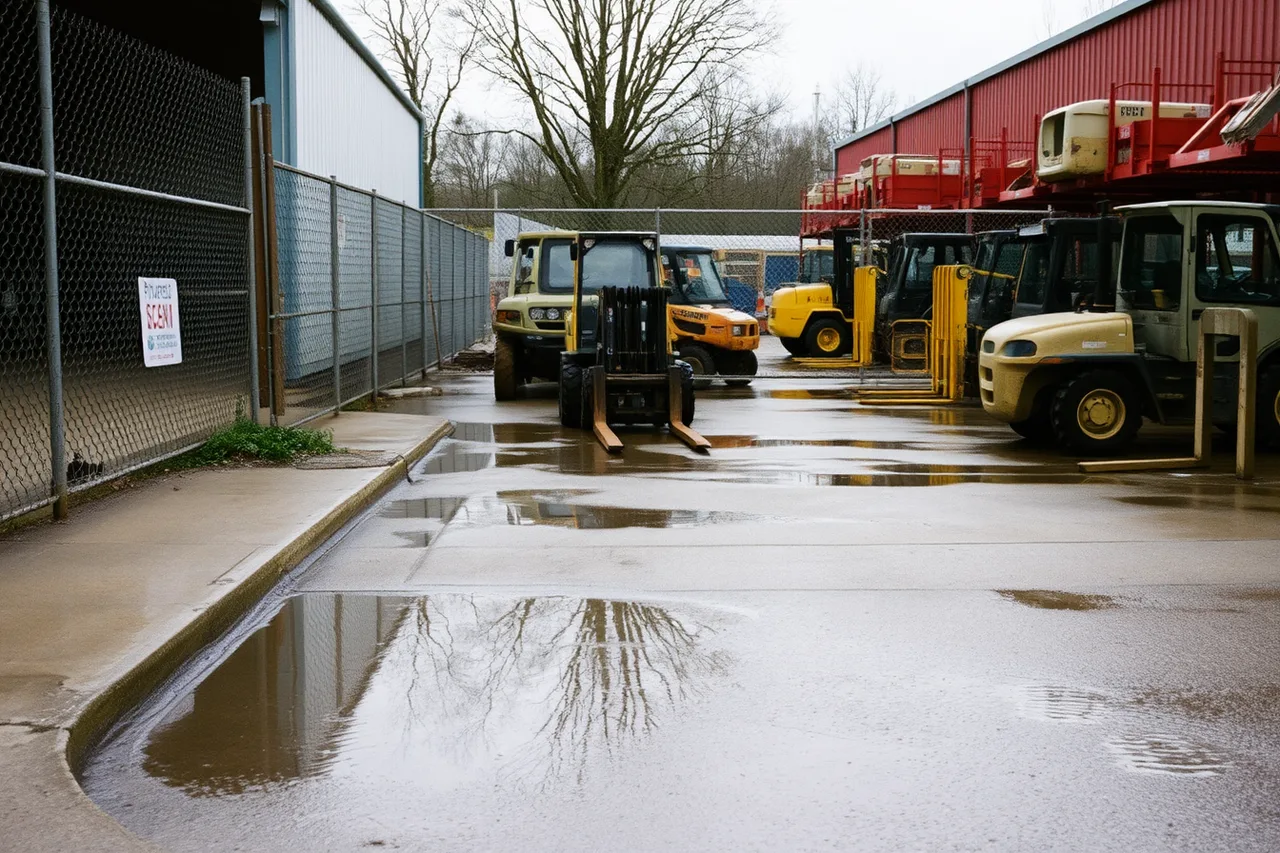
Cause: no fall across the apron and no defined low point with a drain. Consequence: machines sink to the axle, forklifts cannot reach the row, and units sit wet for weeks. Damage claims rise and nobody connects them to grading.
Prevention: set a fall of roughly 1 to 2 percent across the apron toward a designed low point, and keep that low point clear. This is an illustrative range, not a code figure. Check local stormwater rules before you move dirt.
In Phoenix, a 1 to 2 percent fall moves water during monsoon bursts, but a flat low point can still hold silt. In Chicago, freeze and thaw can heave a shallow grade, so keep the fall continuous and avoid a low spot that holds ice.
A second slow failure is the exit route that gets used as storage. OSHA's exit route maintenance standard, 29 CFR 1910.37, requires exit routes to stay free of obstructions. Yards that stack pallets in the fire lane for a few weeks often leave them there for a year.
The cost of these delays is easier to see when you price them out, which is the subject that what equipment rental downtime actually costs sets out in detail.
How to test a layout before you commit
Walk the yard at the busiest hour and time three moves: a return from gate to wash, a wash to staging, and a staged unit to the customer's truck. If any of the three takes more than a few minutes, the layout is the problem.
A simple plan review is cheaper than a redesign. Sketch the flow on paper, mark every point where two paths cross, and remove one crossing at a time. Most yards can cut two or three crossings without moving a fence.
If you are still choosing a site, the monthly cost structure matters as much as the flow. The guide what does an equipment rental yard cost monthly covers the line items that change with layout.
The common cause: planning around parking
Every mistake above shares one trait: the yard was planned around parking rather than movement. Parking is static and easy to draw. Movement is what customers pay for.
The fix is rarely a new building. It is a return lane, a sized wash bay, honest aisle widths, a graded apron and a clear exit route. Those five changes address most of the delay in a typical yard.
Before a redesign, confirm the safety baseline. OSHA rules for equipment rental yards lists what inspectors look at first, and it is worth reading before you move any racking.
If your yard runs in a cold climate, drainage and grading decisions interact with freeze and thaw. 6 steps to winterize an equipment rental yard in Canada covers the seasonal sequence for yards that face hard winters.