Guides
Equipment rental scheduling that avoids delays by work type, buffer, and owner
Equipment rental scheduling works when each work type gets a duration range, buffer, and owner, with delay rules, a daily loading order, and weekly checks.
What to take away
- Give each work type its own duration range, buffer, and named owner instead of one appointment length for everything.
- Book the return inspection and the wash bay before the machine leaves the yard, not when it comes back.
- Compare planned against actual duration every week, and treat a repeated overrun as a scheduling fault, not an operator fault.
- Run a disruption trial on one work type before rewriting the whole board.
- Keep the records that back your invoices, your asset list, and your payroll.
This article covers business systems. Licensing, operator certification, cargo securement, and tax treatment vary by province and state. Confirm current duties with the manufacturer, your provincial OHS authority, and a qualified advisor.
Build the schedule around work types, not around the day
A 20-foot scissor lift going to a warehouse dock and a mini excavator going to a subdivision are not the same booking. They differ in trailer, prep time, site access, and how long the customer actually needs the machine.
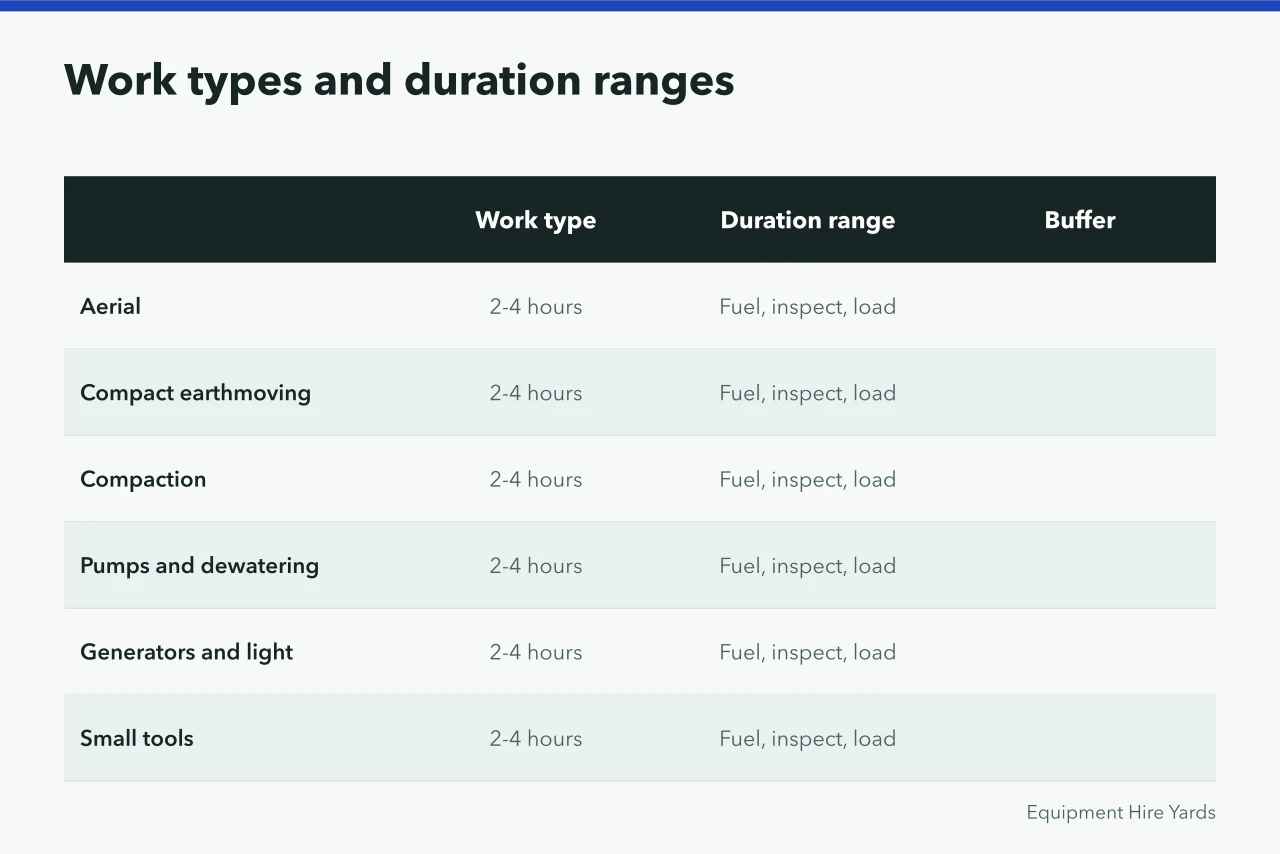
Split your board into work types first. Typical splits in a hire yard:
Work types
- aerial
- compact earthmoving
- compaction
- pumps and dewatering
- generators and light towers
- small tools
For each type, set a duration range rather than a single slot. A range of two to four hours for a small tool delivery absorbs a locked gate without pushing the next job.
Then set a buffer between jobs of the same type. The buffer is the time to fuel, inspect, and load. If your buffer is zero, your schedule is a wish.
A day filled in on that method looks like this:
Build the schedule around work types
| Time | Work type | Duration range | Buffer | Owner |
|---|---|---|---|---|
| 07:00 | Small tools, two drops | 2 to 3 hours | 30 minutes | Counter lead |
| 10:00 | 20-foot scissor lift, warehouse dock | 3 to 4 hours | 45 minutes | Dispatcher |
| 13:30 | Mini excavator, subdivision lot | Half day | 1 hour | Yard lead |
| 15:00 | Pump return and wash | 1 to 2 hours | Wash bay held from 14:30 | Wash bay lead |
Read it top to bottom. The 45 minute buffer after the scissor lift absorbs a late return on the small tools, and the wash bay is already booked before the pump comes back.
Rules that stop the common delays
Most late deliveries trace back to four causes. Each has a scheduling fix.
Delay causes and scheduling fixes
Late return: release booking if not back by grace window
Failed inspection: pull unit off board same hour
Missing attachment: add attachment line to booking
Late return. Charge the next customer's booking against the machine's expected return plus a grace window. If the machine is not confirmed back by the window, the schedule releases the booking to the next available unit.
Failed pre-delivery inspection. A unit that fails inspection comes off the board the same hour. The dispatcher needs a rule for who decides between substituting a similar unit and moving the customer.
Missing attachment. Attachments get their own line on the booking. A breaker without its chisel is a return trip with a trailer.
Site access. Ask for gate width, ground conditions, and the delivery window at booking. A machine that cannot reach the work face is a failed delivery.
Map the day in this order
- Confirm returns due today, with a call to each customer holding a unit.
- Run pre-delivery inspections on everything booked out, and pull failures off the board.
- Match attachments and fuel to each outbound unit.
- Load in reverse delivery order, so the first drop is nearest the door.
- Release the driver with the route, the contact numbers, and the return paperwork.
- Book the return inspection and wash bay before the truck leaves.
Step six is the one yards skip. It is also the one that decides whether tomorrow's board holds.
Daily dispatch order
- Confirm returns due today with customer calls
- Run pre-delivery inspections and pull failures
- Match attachments and fuel to outbound units
- Load in reverse delivery order
- Release driver with route and paperwork
- Book return inspection and wash bay
Fleet mix still shows up on the board
Scheduling gets easier when the fleet matches the demand curve, but fleet acquisition is a separate decision. The table below is the decision, not the answer.
Fleet options and trade-offs
Option
- New purchase
- Runs most days for years
- Used purchase
- Proving demand for new category
- Lease
- Model dates quickly
- Short-term rental
- Seasonal construction peak
- Share or subcontract
- Another operator owns category
Suits when
- New purchase
- Capital committed early
- Used purchase
- Peak downtime costs more
- Lease
- Total cost exceeds buying
- Short-term rental
- Reopens buy-or-rent question
- Share or subcontract
- Lose control of customer experience
Trade-off
- New purchase
- Used purchase
- Lease
- Short-term rental
- Share or subcontract
Suits a hire yard when
- New purchase
- the unit will run most days for years
- Used purchase
- you are proving demand for a new category
- Lease
- the model dates quickly or demand is unproven
- Short-term rental from another yard
- demand is seasonal, such as a construction peak
- Share or subcontract
- another operator nearby already owns the category
Trade-off
- New purchase
- Capital committed before the first rental day
- Used purchase
- Downtime in peak season costs more than the saving
- Lease
- Total cost over the term exceeds buying
- Short-term rental from another yard
- Every rental day reopens the buy-or-rent question
- Share or subcontract
- You lose control of the customer experience
Before committing, run a disruption trial. Put one work type on the new arrangement for one peak season, write down the expected result first, and judge it on the share of disruptions handled inside the agreed path.
What the records have to show
Your schedule is only as good as the paperwork behind it. Three sources set the floor.
The Occupational Safety and Health Administration guidance on powered industrial trucks sets the floor on operator competence, inspection, and pedestrian risk. Under it, the yard must confirm that the operator is trained and evaluated, inspect the truck before each shift, and keep pedestrians clear of the travel path.
The Federal Motor Carrier Safety Administration cargo securement rules set the performance duties for loads, including roll-on and hook-lift containers. For interstate hauls, the yard must secure the load so it cannot shift, use tie-downs rated for the load, and recheck them before the last leg.
The IRS guidance on business records explains that you may choose your own system, but the yard must keep records that show income and expenses clearly and that back up purchases, payroll, and asset values. For the capital side of the same decision, the equipment rental business plan outline covers fleet mix, startup costs, and cash cycle.
Keep the board honest
Review planned against actual duration weekly, by work type. Two numbers matter: on-time completion and average overrun.
Set the target at 95 percent of deliveries arriving inside the booked window, with an average overrun under 30 minutes. Start at 90 percent on a new board. Below 85 percent, the duration ranges or the booking questions are wrong, not the crew.
One delivery vehicle and a dispatcher who also works the counter can hold the board without software. Past two vehicles, the board needs a dispatcher who does nothing else.
When overruns cluster on one work type, the duration range is wrong. When they cluster on one driver or one customer, the booking information is wrong.
Recheck the rules each season. Winter changes prep time, wash time, and what a customer will accept on site. A schedule built for July will fail in Saskatoon in January.
Common questions
How long should a delivery slot be?
Set a range, not a slot. Two to four hours suits most small tool and attachment deliveries. Larger machines with site access risk need a half-day window.
Who owns the schedule?
One named person owns the board and the authority to move a booking. Everyone else escalates. A board with three owners has none.
What is the first sign the schedule is failing?
Repeated overruns on one work type. That points at the duration range, not at the crew.
Do I need scheduling software?
Not at first. A whiteboard and a weekly planned-against-actual review will show whether your ranges are right. Software helps once the yard runs more than one delivery vehicle.