Guides
Equipment Rental Yard Stormwater and Spill Rules for US Yards
EPA stormwater permits, SPCC spill plans and wash-down containment duties for US equipment rental yards, with inspection records and spill thresholds.
What to take away
- A yard holding more than 1,320 gallons of oil in containers of 55 gallons or larger needs an SPCC plan certified by a Professional Engineer under 40 CFR 112.
- Industrial stormwater coverage usually arrives through the EPA Multi-Sector General Permit, where Sector S covers vehicle and equipment maintenance and repair.
- A signed No Exposure Certification removes permitting duties only while industrial materials and activities stay under cover.
- Wash water, fuel drips and hydraulic leaks are non-stormwater discharges, so a floor drain to the storm sewer is a violation rather than a shortcut.
- The records calendar decides whether a yard passes inspection: SWPPP updates, quarterly visual checks, five year SPCC reviews and spill logs.
Which stormwater permit covers a rental yard
Section 402 of the Clean Water Act bans industrial stormwater discharges without an NPDES permit. Yards that fuel, wash, store or repair equipment are the standard case.
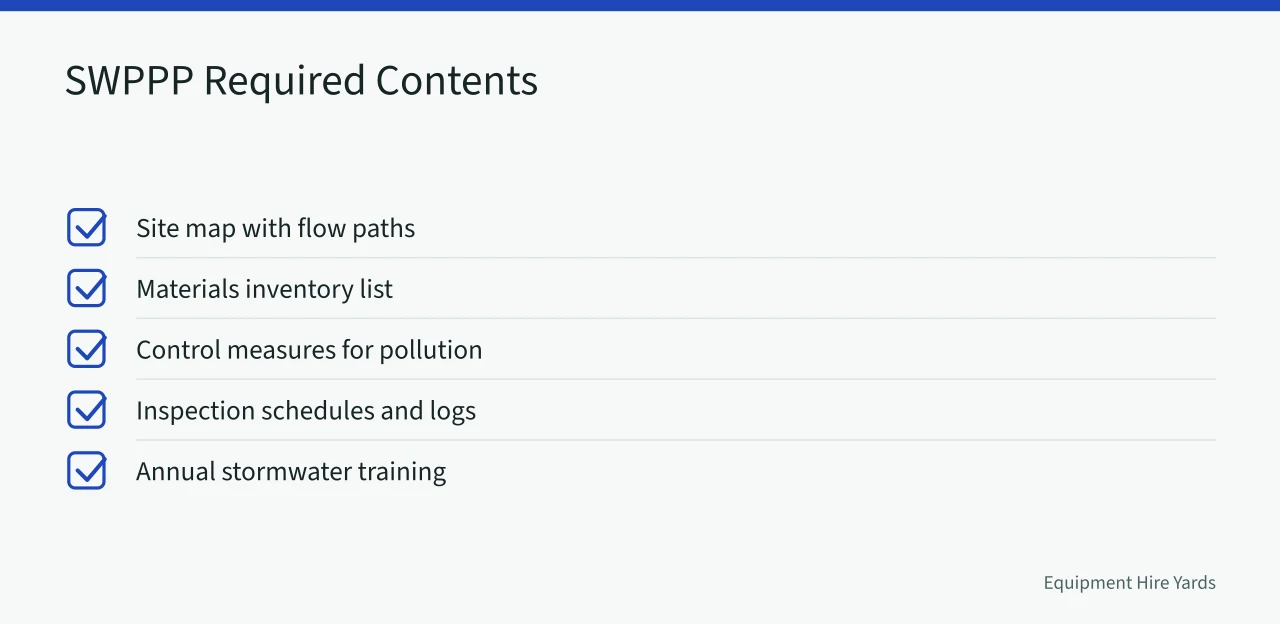
Some states issue their own version, including the California Industrial General Permit and the TPDES multi-sector permit in Texas. Read the state text before copying another yard's plan.
The SWPPP must be signed by a responsible corporate officer and kept at the site. Redraw the map whenever a tank, wash pad or storage row moves.
SPCC plans: what triggers one
| Trigger | Threshold | Main duty |
|---|---|---|
| Aboveground oil storage | Over 1,320 gallons in containers of 55 gallons or more | PE-certified plan, secondary containment, inspections |
| Buried storage | Over 42,000 gallons underground | Plan plus leak detection and corrosion protection |
| Qualified Facility | 10,000 gallons or less, with a clean discharge history | Self-certified plan instead of a PE seal |
| Plan upkeep | Every five years, or within six months of a change | Amended plan and three years of inspection records |
Secondary containment around drums, totes and tanks is sized to hold the largest container plus freeboard for precipitation. Containers get visual inspections on a set schedule, and tanks get integrity testing on a written timetable.
A sheen that reaches a ditch, creek or storm sewer triggers a report to the National Response Center at 800-424-8802, plus state and local notification.
Fuel islands, wash pads and containment
Fuel islands need curbing or a berm, absorbent socks at the pump, dry break nozzles and no drain inside the containment area.
A wash pad works best as a closed loop with a separator, a recycling pad or a holding tank. Detergent does not make runoff clean.
A yard that washes equipment outdoors and lets the water run to a storm drain has turned a housekeeping task into a Clean Water Act discharge.
Storm prep windows for hurricanes and freeze events can overlap a state sales tax holiday, and the tax holiday paperwork rules decide whether the yard can quote a tax free rate.
Sequence the containment work in this order:
- Trace every drain, ditch and low spot, then mark the flow paths on the SWPPP map.
- Curb or berm the fuel island and post a spill kit beside the pump.
- Route wash water to a separator, a recycling pad or a holding tank.
- Set every drum and tote on containment sized for the largest container.
- Log inspections, spills and response times in one binder kept at the yard.
Training and records that inspections ask for
OSHA's Hazard Communication standard, 29 CFR 1910.1200, requires labels and training for the fuels, oils, solvents and cleaners stored in a yard.
Before a drum of solvent arrives, review the SDS binder requirements for yards so labels, secondary containers and training land in one file.
Spill response holds up better when an emergency action plan names responders and drill dates, as 29 CFR 1910.38 describes.
Storage layout matters too. OSHA's materials handling and storage rule, 29 CFR 1910.176, covers clearance for forklifts and stacked material, which keeps aisles open for response crews and drainage.
Inspection logs feed the permit file, so the yard maintenance inspection records belong in the same binder as the SPCC reviews.
Example: a yard that crossed the storage line
Example: a rental yard keeps two 1,000 gallon diesel tanks, eight 55 gallon drums of hydraulic oil and a 275 gallon tote of antifreeze.
Diesel and oil alone total about 2,440 gallons, so the yard passes the 1,320 gallon line and an SPCC plan becomes mandatory. Antifreeze and detergent do not count as oil, but they still belong in the stormwater inventory.