Guides
Equipment rental cash flow basics for owners who hate spreadsheets
Equipment rental cash flow tracking means separating deposits, damage waivers, and maintenance reserves so the yard knows what it earned and what it owes.
What to take away
- Rent is not profit. Split every invoice into rental, damage waiver, fuel, and delivery, because each line behaves differently in the bank account.
- A damage waiver is income until a machine comes back bent. Hold part of it back as a repair reserve.
- Bill deposits and progress payments against the contract, not the calendar month.
- Know your break-even rental days per machine before you quote a rate.
- Reconcile the yard count to the books monthly, or the gap becomes a write-off.
This is general information about running the books of an equipment rental business. It is not tax, legal, insurance, or accounting advice. The IRS, your state tax authority, and a qualified accountant set the rules that apply to you.
Where rental cash actually moves
A rental yard collects money in four streams, and lumping them into one "revenue" line hides which one pays the bills. Rental income is the day rate times the days out. Damage waiver is a percentage of that rate, collected at the counter. Fuel and delivery are pass-through charges that track diesel prices and distance.
Four rental cash streams
Rental income
- How billed
- day rate x days
- When collected
- at counter
- Cost rhythm
- before service
Damage waiver
- How billed
- percent of rate
- When collected
- at counter
- Cost rhythm
- before claim
Fuel
- How billed
- pass-through
- When collected
- after cost
- Cost rhythm
- after driver paid
Delivery
- How billed
- pass-through
- When collected
- after cost
- Cost rhythm
- after pump paid
Each stream has its own cost rhythm. Rental income arrives before the machine needs its next service. Damage waiver arrives before any claim. Fuel and delivery arrive after you have already paid the driver and the pump.
The cash flow cycle of one machine
Money leaves before it returns. A machine is bought or leased, insured, plated if it is road-legal, and serviced before it earns a dollar. Then it sits until a contractor calls.
One machine's cash cycle
- Acquisition cost
- Days idle
- Days out
- Revenue per day
- Maintenance spend
- Downtime days
Track each unit on a simple cycle:
- acquisition cost
- days idle
- days out
- revenue per day
- downtime days The gap between idle days and out days is where cash hides.
Break-even rental days per machine is the number that matters. It is fixed monthly cost divided by the margin per rental day. Fixed cost includes the lease or loan payment, insurance, storage, and scheduled maintenance. Margin per day is the rate minus fuel, delivery, and wear items.
Substitute your own figures. If a machine costs $X a month to own and clears $Y per rental day after variable costs, it needs X divided by Y days out to break even. Anything above that is contribution to the yard.
Bookkeeping steps that fit a rental counter
Bookkeeping steps
- Open a contract record for every outbound machine, with the customer, the unit number, the out date, the agreed rate, and the damage waiver election.
- Record the deposit as a liability, not income. It becomes income only when applied to a final invoice.
- Post rental, waiver, fuel, and delivery as separate lines on the same invoice.
- Log the return inspection the same day, with photos, hour meter, and fuel level.
- Move any damage claim to a repair reserve account until the work is quoted and done.
- Reconcile the yard count to the contract list weekly and the bank to the ledger monthly.
You do not need a spreadsheet. A paper contract ledger with four columns for rental, waiver, fuel, and delivery, plus a running yard count, does the job. Rental software such as Point of Rental does it on a screen, with the return inspection and the repair reserve tied to the contract.
Steps 2 and 5 are the ones owners skip, and they are the ones that keep the books honest.
Rental counter bookkeeping steps
- Open contract record per outbound machine
- Record deposit as liability
- Post rental, waiver, fuel, delivery separately
- Log return inspection same day
- Move damage claim to repair reserve
- Reconcile yard weekly, bank monthly
A worked example of a bent machine
These figures are illustrative. Swap in your own rate and your shop's quote.
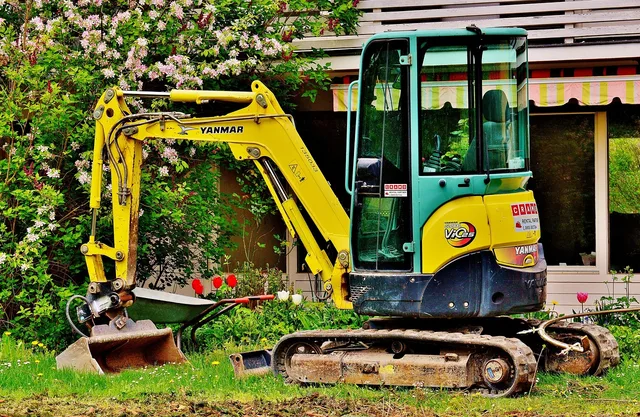
A mini excavator rents for $350 a day. Five days out brings $1,750 in rental income. The damage waiver is typically 10 to 15 percent of the rental line, so call it $263 at 15 percent.
On return, the thumb is bent and the hydraulic line weeps. The shop quotes $1,200 in parts and $600 in labor, so $1,800.
The rental line is earned. The waiver line is earned. Hold the $263 waiver in the repair reserve and leave the invoice open until the quote lands.
Apply the $263 reserve to the $1,800 repair, then bill the customer for the $1,537 that is left. If the contract caps their liability, that balance falls to you. The photos and hour meter from the return inspection are your evidence if they dispute it.
The same machine breaks even at 9 rental days a month. Fixed cost is $2,100 a month, covering the loan payment, insurance, storage, and scheduled service. Margin per day is $240, which is the $350 rate minus about $110 in fuel, delivery, and wear items. Divide $2,100 by $240 and you get 8.75 days.
Five days out covers a bit over half of break-even. If the unit sits for the rest of the month, the $1,800 repair eats the month.
Fleet performance and market demand
Which machines earn their keep, and which markets justify owning them, are the same question asked twice. The equipment rental software and KPI guide covers the reporting side. The best markets for an equipment rental business covers where the demand sits.
Records and controls
Keep contracts, inspection sheets, fuel receipts, delivery logs, and repair invoices for at least three years after you file that year's return. Keep purchase and repair records for a machine until three years after you dispose of it. The IRS recordkeeping guidance explains what a clean record set looks like, and the principle carries across borders.
If you take card payments or store customer data, the CISA small business guidance covers the basics of protecting it. The NIST quick-start guides give a plain starting point for risk management.
None of these replace your accountant. They tell you what questions to bring.
Common questions
Should a damage waiver be taxed like rent?
It depends on your jurisdiction and how the waiver is written. Some authorities treat it as part of the rental charge and some treat it as a separate service. Ask your accountant and confirm with the IRS or your state tax authority before you set the line up.
How often should the yard count be reconciled?
Weekly is the practical answer for an active yard. Monthly reconciliation lets small discrepancies compound into a write-off you cannot explain. The count should match the open contract list, not just the physical yard.
What is the simplest KPI for a small fleet?
Break-even rental days per machine. It turns a pile of fixed costs into one number the owner can compare against the booking calendar. If a unit never clears it, the problem is the rate, the demand, or the machine.