Guides
Monthly metrics for an equipment rental business, and what each one signals
Monthly equipment rental metrics show fleet use, damage cost, late returns and cash timing, so a yard can price, staff and buy machines on evidence.
What to take away
- Monthly metrics for an equipment rental business start with time utilization, which tells you whether the fleet earns its keep. A machine at 45 percent is a machine you bought for someone else's schedule.
- Damage waiver recovery and damage cost per machine belong on the same page. One without the other hides whether a waiver priced near 14 percent covers real repairs.
- Days sales outstanding and cash conversion cycle decide how many machines you can buy next year, not the size of the rate card.
- Cost per machine hour includes maintenance, downtime and delivery. A rate that beats a competitor on paper can still lose money on a machine.
- Track the same eight numbers every month, in the same order, so a change means something.
This article covers general equipment rental operations, not individualized legal, tax, safety or contract advice. Requirements vary by province, machine and customer, so confirm current duties with the manufacturer, your provincial OHS authority, and a qualified professional.
The eight numbers, and what each one signals
Time utilization. Billable machine hours divided by available machine hours for the month. It signals whether fleet size matches demand. Yards commonly run 60 to 70 percent; three months below roughly 55 percent means storage, insurance and interest on idle iron are eating the margin.
Key rental metrics and benchmarks
- 60-70%typical time utilization
- 55%three months below signals idle iron
- 85-95%typical rental rate realization
- 14%waiver priced near rental charge
Revenue per machine. Monthly rental revenue divided by the number of units in the fleet. It signals which classes earn their space in the yard. Run it by class: a 40-foot boom lift renting at $2,000 to $3,000 a month and a plate compactor at $300 to $500 do not belong in one average.
Rental rate realization. Actual invoiced rate divided by your published rate. It signals discounting. Typical realization lands between 85 and 95 percent. If it drifts down while utilization holds steady, someone is buying volume with margin.
Damage waiver recovery. Waiver revenue divided by repair cost for the same period. It signals whether the waiver price is set correctly. Waivers are commonly priced near 14 percent of the rental charge. One bent mast on a telehandler can erase a quarter of waiver income.
Damage cost per machine. Repair and parts cost divided by units in the fleet. It signals operator training and site conditions. A single class running high usually points to one customer or jobsite, not a fleet-wide problem.
Maintenance cost per machine hour. Parts, labor and outside service divided by billable hours. It signals when a unit should leave the fleet. Compare it against the machine's own history, not against other classes.
Downtime hours per machine. Hours a unit is unavailable while it should be rentable. It signals whether your service bay, parts stock or technician count is the constraint. It also feeds directly into lost revenue.
Days sales outstanding. Accounts receivable divided by average daily revenue. It signals collection speed. Rental yards typically run 45 to 60 days, and construction accounts often sit at the long end. The asset is already out the gate, so slow collection hits harder than in most trades.
Worked example: one excavator, one month
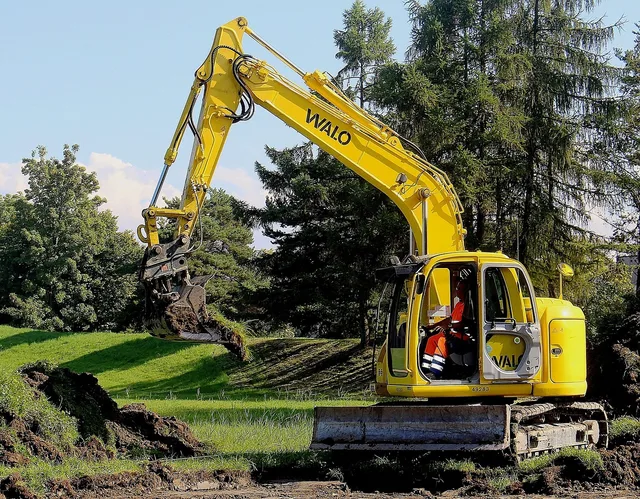
Take a 5-ton excavator, a Caterpillar 305 CR or a Kubota KX057, with a published rate of $R per day, 22 rentable days in the month, and 14 days actually billed. Time utilization is 14 divided by 22, or 64 percent.
One excavator, one month
- 22rentable days in month
- 14days actually billed
- 64%time utilization
- $400daily rate example
That size of machine typically lists at $350 to $500 a day in most US markets, so 14 billed days at $400 brings in $5,600 of rental revenue before the waiver.
Maintenance and repairs for the month are $M. Delivery and pickup cost $D. Damage waiver income is $W, often 14 percent of the rental charge. Net contribution is (14 x $R) + $W minus $M minus $D.
Run that for every unit and the fleet sorts itself. Machines negative for three straight months are candidates for sale, not another season.
Where the numbers come from
Rental software such as Point of Rental, Texada and InTempo by Zucchetti produces most of these directly, but the definitions have to be set before the first report runs.
Decide now whether a machine on a long-term contract counts as available, and whether a unit in the shop for scheduled service counts as down. Changing the definition later makes every prior month useless.
The equipment rental software and KPI guide covers how to configure those definitions in a rental management system. The American Rental Association publishes a Cost of Doing Business report that US yards use to benchmark time and dollar utilization.
If you are still writing the operating model behind the numbers, start with the equipment rental business plan and bring the metrics in as targets.
Where to buy, lease or rent the machines
Buy, lease or rent machines
Buy new
- Best when
- near daily use
- Trade-off
- depreciation starts
- Example cost
- $70k-$95k
Buy used
- Best when
- proving demand
- Trade-off
- missing history
- Example cost
- auction price
Lease
- Best when
- cash needed elsewhere
- Trade-off
- costs more total
- Example cost
- finance term
Short-term rent
- Best when
- rare rental day
- Trade-off
- fails on busy days
- Example cost
- daily rate
Suits an equipment rental business when
- Buy new from a dealer (Caterpillar, John Deere, Bobcat)
- the machine will run near daily for years
- Buy used at auction (Ritchie Bros., IronPlanet)
- you are proving demand before committing capital
- Lease through a manufacturer finance arm (Cat Financial, Kubota Finance)
- cash is needed for fleet and marketing at once
- Short-term rental from a national supplier (United Rentals, Sunbelt Rentals, Herc Rentals)
- a rare rental day needs a unit you do not own
Trade-off
- Buy new from a dealer (Caterpillar, John Deere, Bobcat)
- Depreciation starts the day it arrives; a new 5-ton excavator typically lists between $70,000 and $95,000
- Buy used at auction (Ritchie Bros., IronPlanet)
- Service history is often missing
- Lease through a manufacturer finance arm (Cat Financial, Kubota Finance)
- Total cost exceeds buying over the term
- Short-term rental from a national supplier (United Rentals, Sunbelt Rentals, Herc Rentals)
- Availability fails on the busiest days
What to verify before acting
National Institute of Standards and Technology: NIST Small Business Quick-Start Guides is a checkable starting point for protecting the customer and contract data behind these numbers.
Cybersecurity and Infrastructure Security Agency: Cyber Guidance for Small Businesses covers the operational risks that show up as downtime and disputes.
Internal Revenue Service: What kind of records should I keep? explains the records behind purchases, payroll and assets. In Canada, the CRA sets the equivalent record-keeping duties, and a tax advisor confirms what applies to you.
Common questions
Why is time utilization the first metric?
It tells you whether the fleet is the right size before any other number matters. A yard can have strong rates and still lose money if half the iron sits idle paying insurance and interest.
What is a normal damage waiver rate?
Waivers are commonly priced near 14 percent of the rental charge in the US. Check the recovery ratio monthly, because the waiver price and the repair bill move at different speeds.
Should I compare my numbers to an industry benchmark?
Use benchmarks as a sanity check, not a target. Machine mix, climate and customer base vary too much. Your own twelve-month history is the comparison that changes decisions.
How often should the fleet mix change?
Review it quarterly, act monthly. A class that stays below your utilization floor for three months is a candidate for sale or for a rate change, and the monthly numbers are what tell you which.