Guides
OSHA Rules for Equipment Rental Yards: What to Inspect Before a Visit
OSHA rules for equipment rental yards decide what a compliance officer can cite on arrival. Here is what to inspect, and what skipping it costs.
What to take away
- Federal OSHA sets the baseline through 29 CFR 1910 for general industry, and yard owners in state-plan states answer to a state agency that can add its own standards on top.
- Inspectors rarely arrive without a reason. A complaint, a serious injury, or a programmed inspection of your industry puts a compliance officer at your gate.
- The citations that show up in yards cluster around powered industrial trucks, lockout/tagout, machine guarding, walking-working surfaces, and hazard communication.
- A citation can carry a penalty per violation, and repeat or willful classifications raise it sharply. The bigger cost is usually the abatement deadline and the lost days that follow.
- The documents that matter most are the ones you should already have: training records, inspection logs, hazard assessments, and the written programs behind them.
Who has jurisdiction over your yard
Federal OSHA covers private employers in roughly half the states directly. The rest run an OSHA-approved state plan, which must be at least as effective as the federal standard and may go further. California's Cal/OSHA and Michigan's MIOSHA are the examples most yard owners run into, and both add requirements the federal text does not contain.
Municipal rules sit on a different track. Zoning, fire code, and stormwater permits come from the city or county, not from OSHA. A yard can pass a federal inspection and still be shut down by a local fire marshal over blocked exit routes.
Private rules arrive through insurance carriers and equipment manufacturers. A carrier's loss-control visit is not an OSHA inspection, but the findings often mirror one, and the manufacturer's service manual can set a standard a compliance officer will treat as the industry norm.
What triggers an inspection
- A complaint or referral, which OSHA handles by evaluating whether the allegation is credible and specific.
- A fatality or a hospitalization, which triggers a report to OSHA within 8 hours for a death and 24 hours for an inpatient hospitalization, amputation, or loss of an eye.
- A programmed inspection, where the agency targets industries with high injury rates under a regional or national emphasis program.
- A follow-up visit to confirm that a previous citation was abated.
A compliance officer can arrive unannounced. There is no appointment to prepare for, and the opening conference is where the scope of the visit gets set.
What the officer will inspect
| Area | Standard | What the officer looks for |
|---|---|---|
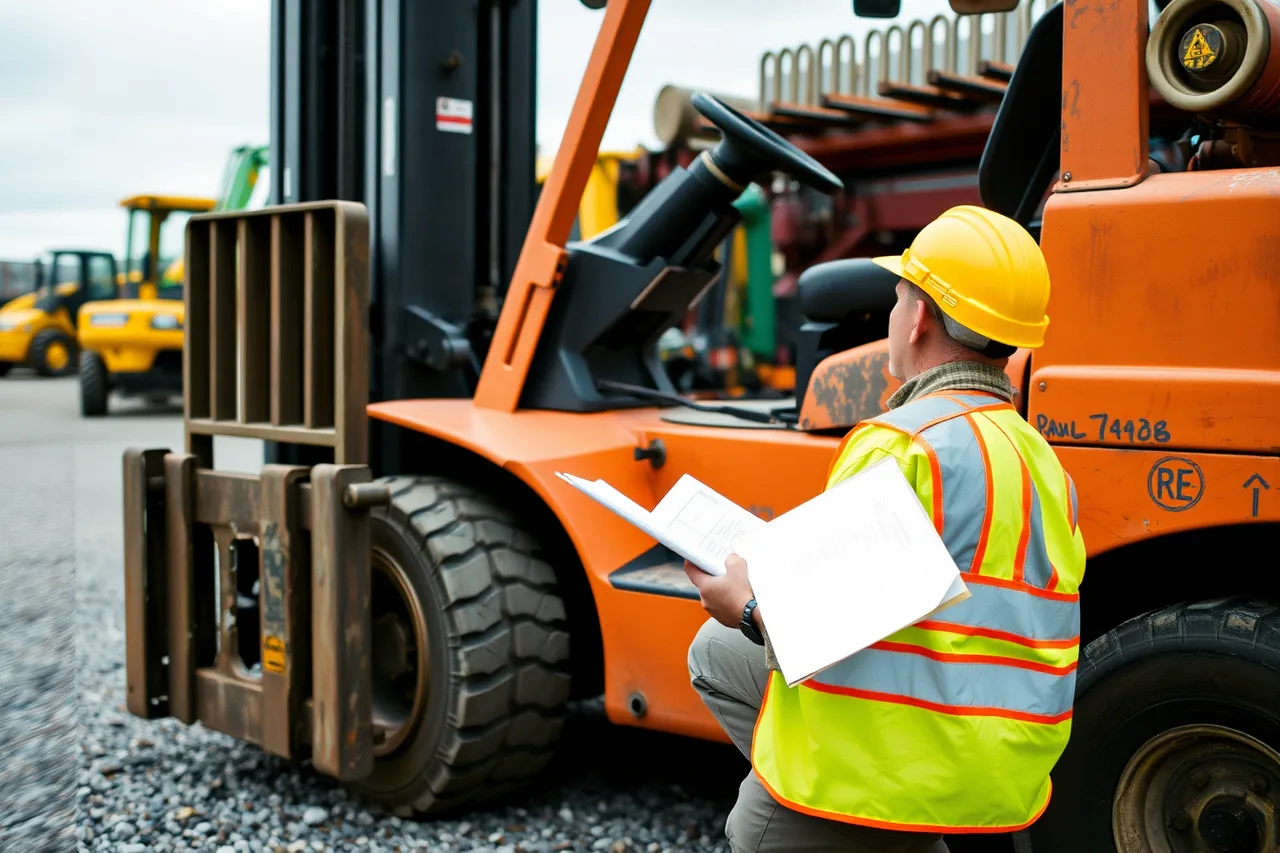
| Forklifts and loaders | 29 CFR 1910.178 | Operator training and evaluation records, pre-shift inspection logs, seat belts, damaged forks |
| Servicing and repair | 29 CFR 1910.147 | Energy control procedures, lockout hardware, periodic inspection of the procedure |
| Shop machinery | 29 CFR 1910.212 | Guards on belts, pulleys, and blades, and whether they are actually mounted |
| Yard surfaces and racks | 29 CFR 1910.22 and 1910.176 | Aisles kept clear, stable stacking, drainage, housekeeping in the return lane |
| Chemicals and fuels | 29 CFR 1910.1200 | Labels, safety data sheets, and documented training for every exposed worker |
Documents to have ready
The opening conference usually turns into a document request. Have these assembled before anyone asks.
- Written safety and health program with the person responsible named
- Training records with dates, topics, and trainer names for each employee
- Equipment inspection logs, including the pre-use checks on powered industrial trucks
- Hazard assessment certification for personal protective equipment
- Injury and illness records for the past five years, plus the current OSHA 300A posting
Missing records are their own violation in several of these areas. Training that happened but was never documented is difficult to prove after the fact, which is why the paper trail is the inspection.
What happens if you skip it
OSHA grades violations as other-than-serious, serious, repeat, or willful. The penalty per violation rises with each step.
A serious violation can be cited when death or serious physical harm is substantially probable and the employer knew or should have known of the hazard. Failure to abate by the assigned date can add a daily penalty until fixed.
The concrete consequence that catches yards is not the fine. It is the abatement letter with a deadline, the follow-up inspection that confirms it, and the repeat classification if the same condition reappears at a second location. A repeat finding moves the citation into a higher penalty tier and stays on the record.
There is also the insurance side. A carrier that sees an OSHA citation at renewal can raise the premium or require a corrective action plan before it renews at all. For a yard running on thin margins, that renewal conversation is the expensive part.
State-plan differences worth knowing
California requires an Injury and Illness Prevention Program from every employer, which is broader than anything in the federal text. Michigan runs its own consultation service and its own citation schedule. Both states can inspect where federal OSHA might not have the resources to.
If you operate across state lines, the practical rule is to build to the strictest state you work in and apply it everywhere. That removes the need to track which yard follows which version of a training requirement.